Book A Call

From Page 1 to Prompt 1: How GEO Keeps You Visible in AI Search

From Search Engines to Answer Engines
Person using AI search on a device

Traditional SEO is about getting your content found by Google and clicked on by people. That is still incredibly important, especially for e-commerce, local services, or when someone is ready to buy, book or contact you. For these kinds of high-intent searches, Google remains the go-to platform and is likely to stay that way.

However, AI platforms like ChatGPT, Perplexity and others are quickly becoming the first place people go when they have questions. These could be anything from “how to clean white trainers” to “best ways to save on energy bills”. These tools generate answers instantly, often without showing the source. That means your content must now do more than rank; it must be usable, understandable and quotable by AI. Google’s new AI-powered summaries (known as Overviews) are a case in point: brands that optimise for AI Overviews stand a far better chance of being cited. The same applies when Alexa or Google Assistant recommends a local provider.

It is also worth noting that AI platforms are starting to recommend local and trusted businesses when users ask directly for services. Whether someone is speaking to Alexa, Google Assistant or asking ChatGPT for “a reliable plumber in Bristol”, the AI might surface a shortlist of nearby providers. The businesses that are best structured and most clearly represented online are more likely to be included in those suggestions. This makes your local SEO and reputation management even more important.

What is Generative Engine Optimisation (GEO)?

GEO is the practice of optimising your content so it is more likely to be used in AI-generated answers. It is about ensuring your expertise can be discovered and understood by large language models, the same way SEO helps Google understand and rank your content.

This includes:

  • Writing clearly and directly, especially in question-and-answer formats
  • Using consistent brand mentions and expert phrasing
  • Structuring content with headings, bullet points and FAQs that AIs can easily parse
  • Adding schema markup and structured data to help machines interpret your pages

In other words, if SEO gets you found in search results, GEO helps you be quoted in AI responses.

SEO is not dead. GEO builds on it.

SEO and GEO working together

There is a lot of noise out there suggesting that AI is killing traditional SEO, that is simply not true. SEO remains the foundation for online visibility, particularly when someone is looking to act. 90% of pages get zero organic traffic, underscoring just how critical solid optimisation still is.

Whether someone is trying to find a plumber near them, browse holiday packages, or compare service prices, they still go to Google. And Google still values high-quality content and technical optimisation.

In fact, AI models often use websites that rank well on Google as their source of truth. That means strong SEO can actually support your visibility in AI tools.

GEO does not replace SEO; it builds on it. At Brace, we make sure your content is optimised for both search engines and AI tools so your brand is visible wherever people are looking.

What’s in it for You?

So why should you care about GEO? Because visibility is no longer limited to ten blue links. People are getting their answers from many sources, and you need to be in those answers.

More exposure, even without a click

If your business is mentioned, quoted or used as a source in AI-generated content, it increases your brand visibility, even if the user never lands on your site.

Builds trust and authority

When AI tools reference your expertise, it positions you as a trusted voice in your industry.

You stay part of the buying journey

Even if AI provides the first touchpoint, users often go on to search, compare and purchase. GEO helps you stay present in that journey.

Future-proofing your content

Search behaviour is changing. By adapting now, you are setting yourself up for long-term success.

What Brace Does Differently
Brace approach to GEO and SEO

At Brace, we are not separating GEO from SEO. Instead, we see it as a natural evolution of how people search. Our SEO strategies already include:

  • AI-friendly content structures that are easy to understand and reuse
  • Schema markup, FAQs and formatting designed to support both Google and AI platforms
  • Content strategies that answer real user questions in natural, helpful ways
  • Technical audits ensuring your website is fast and optimised for both humans and AI bots
  • Ongoing research into how AI tools surface and summarise information

You do not need to choose between SEO and AI. We make sure your business is discoverable on Google, but also positioned to be part of AI-generated answers when it counts. By aligning every piece with Google’s helpful content framework, your pages will perform in both traditional results and AI-powered summaries, giving you an advantage over competitors that don’t.

Final thoughts: SEO still matters. GEO just makes it Stronger.

Your website is still a key part of how people find and trust you. Google is still a major player, and that is not changing overnight. But the way people search is expanding, and your strategy needs to expand with it.

At Brace, we help you stay visible wherever your audience is looking, whether that is on a search results page or inside a chatbot. GEO is not a replacement for SEO. It is the next step.

Ready to make sure your content is future-proof? Let us help you move from page one to prompt one.

Marketing Terms Explained: A Simple Guide for Business Owners

How buyer behaviour is shifting

AI isn’t something that’s coming later. It’s already changing how people search, compare options, and decide who to trust.

We’re seeing more early research happen before a user ever reaches a website, whether that’s through Google’s AI Overviews or inside tools like ChatGPT and Perplexity. That often means fewer clicks from people at the start of their research. The upside is that the clicks you do get are usually more qualified, with people looking for proof, pricing, reassurance, or a clear next step.

That changes what visibility really means. It’s no longer just about appearing in search results. It’s about being clear and credible enough to be understood quickly, both by people and by AI tools.

The businesses benefiting most tend to make that easy. Their messaging is specific, their offer is clear, and the proof is there. The ones that struggle usually have the opposite problem: vague services, limited proof, and websites that leave too much unsaid. That makes them harder to trust and easier to overlook.

AEO

AEO stands for Answer Engine Optimisation. It means writing your content so search engines and AI tools can easily use it as a direct answer.

You’ve already seen this in action, even if you have not heard the term before. It shows up in places like featured snippets, “People also ask”, and AI summaries. It’s where a platform pulls a short section of text from a website and shows it straight on the results page.

AEO works best when your content is built around real customer questions. Think about the things people genuinely want to know before they choose a supplier, like: what it costs, how long it takes, what the process looks like, what to watch out for, and common mistakes to avoid.

The key is clarity. If your pages are easy to scan and get to the point quickly, they’re far more likely to be picked up and shown as an answer.

A good starting point is to review your main service pages and add clear headings, short paragraphs, and a simple FAQ section that mirrors the questions your customers are asking.

AI Search

GEO

If AEO is about showing up as the direct answer, GEO is about showing up inside the AI-generated answer itself.

GEO stands for Generative Engine Optimisation. It’s the work that increases the chances of your business being mentioned or referenced when someone uses an AI tool to ask a question like, “I am [insert] type of runner, which [brand] would suit me best?” or “Which brand of padel balls are the best?”

The reason GEO matters is that AI tools are increasingly being used to shortlist options. People aren’t always clicking ten different websites anymore. They’re asking a tool to summarise the best options and then deciding what to do next.

So, your visibility isn’t only about rankings, it’s also about whether your business is clearly understood and trusted enough to be included in the summary.

AIO

You may also come across AIO, which is often used as a broader umbrella term.

AIO stands for AI Optimisation. It’s about improving how your brand shows up across AI-influenced search and discovery, whether that’s through AI summaries, conversational results, or recommendation style answers.

It helps to think of AIO as the bigger picture. It brings together the things that make a brand easier for AI tools to understand and trust: clear content, strong visibility in AI answers, credible proof, and a digital presence that’s consistent across the web.

For most businesses, AIO isn’t a brand new channel to chase. It’s a sign of where AI search is heading. The brands that perform well tend to be the ones that are clear about what they do, back it up with evidence, and make it easy for both people and platforms to understand them.

That’s why the fundamentals matter so much here. If your messaging is vague or your online presence is inconsistent, AI tools have far less to work with. If it’s clear, specific, and trustworthy, you’re in a much stronger position.

LLM

An LLM is a Large Language Model. It’s the technology behind tools like ChatGPT, Gemini and Claude. These models generate answers by learning patterns in large amounts of data.

For most business owners, the technical detail matters less than what these tools are now being used for. They’re built into search engines, browsers, and workplace tools, and people are starting to use them to research options, compare suppliers, and make decisions more quickly.

You can see this happening in tools like ChatGPT search, which blends conversational answers with links to web sources.

That means your business can be judged before someone ever reaches your website. If the information AI tools find about you is vague, outdated, or inconsistent, the picture they build may be incomplete or not strong enough to include you at all.

This is why your website matters in a slightly different way now. It’s no longer just where people land after searching. It’s also part of the information AI tools use to understand who you are, what you do, and whether you’re worth recommending.

A good place to start is by checking your key pages for clarity. It should be obvious what you do, who you help, where you operate, and what makes you different.

Google AI overviews

E-E-A-T

You’ll often hear E-E-A-T mentioned in the same conversations around search and AI.

It stands for Experience, Expertise, Authoritativeness, and Trust. It’s about how credible your business looks online. As search engines and AI tools try to surface the most reliable information, those trust signals matter more.

E-E-A-T isn’t something you “add” to a page. It’s built over time through the way your business shows up online, the proof you provide, the clarity of your information, and the confidence your content gives people.

That’s why businesses with strong case studies, detailed testimonials, clear service pages, and visible expertise tend to stand out more. They make it easier for both users and search platforms to understand who they are, what they do, and why they can be trusted.

A good place to start is by looking at the signals your site already gives off. Are your business details clear? Do your pages show real experience? Is there enough evidence on the page to back up what you say? If not, that’s usually where the work starts.

Zero-click search

And finally, zero-click search.

Zero-click search is when someone searches on Google, gets the answer directly on the results page, and never clicks through to any website.

AI features accelerate this trend. Google also shares how its AI search features work and how they’re intended to connect users with helpful sites. Instead of sending people off to explore multiple pages, search results are increasingly designed to answer the question immediately through snippets, summaries, and AI overviews.

The important point is what this means for your marketing. You might see fewer clicks overall, but the clicks you do earn can be higher intent. If someone leaves an AI summary to visit your website, they’re often deeper in the decision process and looking for specifics like, proof, pricing, process, or reassurance.

This is why we encourage businesses to measure more than traffic. What matters is what traffic turns into: enquiries, calls, bookings, sales and how effectively your website converts people once they land.

The simple takeaway

You don’t need to memorise every acronym.

But you do need to understand what’s changing. More decision-making is happening inside answers and not just on websites. That means your brand needs to be easy to understand, easy to trust, and ready to convert the traffic you earn.

At Brace, we help businesses stay visible as search evolves. From SEO and content, through to GEO and AIO, and the practical improvements that turn visibility into enquiries.

If you want a clear view of how your business shows up in AI-driven search, contact us and we can help you identify what to prioritise first, and what will make the biggest difference.

GEO: What It Is, Why It Matters, and What to Do About It

AI search is changing how people find businesses online. Instead of clicking through a list of links, more users are now getting answers, recommendations, and comparisons directly inside AI tools and AI search features. We focus on what’s practical and useful. So, here’s the simple version of what GEO is, why it matters, and what to do next.

What is GEO?

GEO stands for Generative Engine Optimisation. It’s about increasing the chances of your business being mentioned, recommended, or referenced inside AI-generated answers. Think tools like ChatGPT, Google’s AI results, Gemini, Perplexity, and other tools that prioritise answers over lists of links. Instead of showing ten blue links and letting people decide, these tools often summarise options and suggest next steps. GEO is about making sure your brand has a chance to be part of that summary.

Why GEO is suddenly everywhere

Search behaviour is changing.

McKinsey reports that “half of consumers already use AI-powered search, and that behaviour is expected to influence $750 billion in US revenue.” Also notes around 50% of Google searches already include AI summaries, with that figure expected to rise further over the next few years.

That matters because people are no longer only browsing lists of links. They’re using AI tools to compare options, shortlist suppliers, and speed up research. If your business isn’t easy to understand online with clear services, clear expertise, and clear proof, you can be overlooked, even if you’re the right fit.

How user behaviour is changing (and what that means for clicks)

Search is becoming more conversational. People are asking fuller questions, adding context, and looking for quick, trustworthy answers. AI search features are designed for exactly that, which means more queries are being answered inside the platform. Users get what they need from AI summaries and answer engines, so fewer people click through to websites.

McKinsey also highlights that brands may see 20 – 50% declines in traditional search traffic if they’re unprepared, as more decision making happens before the click. At the same time, the remaining clicks often come from users who are further along in the journey.

That means the clicks you do earn can be higher intent, people looking for proof, pricing, process, or a clear next step.

This is why GEO matters. It helps you show up in the answers that shape decisions and supports better-quality traffic when users do click through.

ChatGPT

GEO vs SEO: what’s the difference?

SEO is largely about helping your website rank in search results. GEO is about helping your brand be included in generated answers.

The overlap is bigger than you might think. Strong SEO foundations still matter: GEO simply puts more emphasis on clarity, structure, and the expertise, experience, authority and trust signals AI tools can interpret quickly.

The biggest myth about GEO

Myth: “GEO is a brand-new strategy and everything we’ve done for SEO is now outdated.”

Reality: GEO is an evolution, not a reset.

If your website is vague, thin on detail, or light on proof, it was already underperforming in SEO terms. GEO simply exposes those weaknesses faster, because AI tools prefer information that’s confident, consistent, and easy to summarise.

What AI tools tend to reward

You don’t need to “hack” GEO. You need to become easier to understand and easier to trust.

Clear positioning

Be specific about what you do, who it’s for, and the outcomes you deliver. Avoid copy that could belong to any business.

Strong service pages

The best service pages explain the process, the value, what to expect, and the problems you solve, not just a list of features.

Real proof

Case studies, testimonials, results, accreditations, and examples of work make you easier to trust (and easier to reference).

Consistency across the web

AI tools draw from multiple sources. Your website, reviews, listings, and social proof should tell the same story. Mixed messaging makes it harder to categorise your business accurately.

AI Chat GPT

What you should do next

If you want to act on GEO without overcomplicating it, start here.

First, tighten your core pages. Your homepage, about page, and service pages should answer the basics quickly: what you do, who you help, why you’re trusted, and how to take the next step.

Next, publish content based on real customer questions. Think pricing approach, timelines, comparisons, “what to look for”, and common mistakes. This is the type of content AI tools are built to surface.

Then, strengthen your proof. If you’re good at what you do, show it. Make testimonials specific, add outcomes to case studies, include numbers where you can and use third-party review plugins to add independent trust signals.

Finally, don’t ignore the technical basics. Speed, structure, and accessibility still matter. If your site is hard to crawl or interpret, it’s harder to surface in any search experience.

The simple takeaway

GEO isn’t a separate channel. It’s a sign that visibility is expanding beyond traditional rankings and into AI-generated answers.

The brands that win won’t be the ones chasing acronyms. They’ll be the ones with clear messaging, credible content, and a digital presence that’s easy to understand and trust.

At Brace, we help businesses stay visible as search evolves. If you want to understand how your brand shows up in AI-driven search and what to prioritise next, we can help.

Speak to our team on 01452 729953 or fill in our contact form and we’ll help you build visibility that performs now and holds up long term.

SEO vs. PPC? Why Your Business Needs Both

Many business owners ask the same question. “Should I put my money into SEO or PPC?”. It sounds like a choice; one or the other. But in most cases, that’s not how it works. For small to medium-sized businesses, the best results often come when the two work together. SEO builds your presence over time. PPC brings results fast. When you combine them, they support each other and drive stronger results than either can on its own.

So, what are SEO and PPC?

First, let’s break down what these two terms mean.

PPC stands for Pay-Per-Click. This is paid advertising on search engines. You pay when someone clicks on your ad, and it gets you seen straight away. It’s great for bringing in traffic and leads fast. The price you pay for this will depend on the popularity of the keywords you are targeting, both from a search perspective and how many competitors in your industry are paying for them too.

SEO stands for Search Engine Optimisation. It’s all about improving your website so that people find you organically, without paying search engines for each click. It takes time, but it builds trust and brings in steady traffic over the long run.

The best SEO is created with a focus on Google’s quality guidelines, which reward trustworthy, helpful content often referred to as E-E-A-T (Experience, Expertise, Authoritativeness, and Trustworthiness). The better your content performs in those areas, the more likely it is to rank well.

Here are a few key elements of SEO that help build organic visibility:

  • Keywords: These are the words and phrases people type into search engines. For example, if you’re a skip hire company, keywords like “cheap skip hire [your location]” or “book a skip online” would be relevant.
  • Fresh content: Regular blog posts, updates to existing pages, or new service pages signal to Google that your site is active and helpful.
  • Internal and external links: Linking to other relevant pages on your site and to trusted external sources helps Google understand your content and build authority.
  • Image optimisation and alt attributes: Every image should have an alt tag, useful for SEO and accessibility.
  • Meta descriptions: These short blurbs summarise each page and can impact click-through rates from search results.
  • H1-H3 headers: These structure your content and make it easier for readers and search engines to understand.
  • Word count: Long-form content (generally over 800–1,000 words) tends to perform better, especially when it’s well-structured and genuinely useful.
  • Page Speed Insights: These are key performance metrics Google uses to assess user experience. This includes how fast your site loads, how quickly it becomes interactive, and how visually stable it is during loading. A slow, jumpy website can negatively impact rankings and frustrate users, so it’s important to keep it optimised and running as quickly and as smoothly as possible.

Why Integrate SEO and PPC?

When SEO and PPC work together, the impact is much bigger than using either one on its own.

  • More visibility: Showing up in both the ads and the organic results means you have double the space in search engine result pages. This increases your chances of getting visitors to your website.
  • Quicker insights: PPC gives instant data on what people search for and what journey they take on your website. That information can guide your SEO work.
  • Identifying keyword gaps: Perhaps your visibility is weak for certain keywords on the SEO front. PPC can help fill these gaps, making sure you have visibility across the board.
  • Test, test and test! Ads give fast feedback on which headlines and descriptions get the best response. Those learnings can then shape your SEO content.
  • Audience targeting: With PPC, it’s not just about the search results. You can target specific audiences based on demographics, search intent, behaviour, and remarketing lists. Campaign types like Display Ads and Performance Max make it possible to stay in front of people at different stages, even when they’re not actively searching.

Costs & ROI

With SEO, you don’t pay for each click. The main cost is the time and effort it takes to create content, improve your website and keep it in good shape. The results tend to build slowly, but the traffic you gain can keep coming in without extra spend once your pages rank well.

PPC is slightly different. You set a budget and pay search engines every time someone clicks on your ad. It can feel more expensive, but it also gives results very quickly. When it’s managed well, PPC can be a very controlled way to bring in leads because you can track exactly what you spend and what you get back. Unlike the old school way of placing an expensive advert in a newspaper or magazine, you can also see exactly what PPC ads are working for you, and the value for money you are receiving.

Think of SEO like buying a house. It takes more time and effort at the start, but once you’ve done the work you own something that keeps giving value without extra payments each month. PPC is more like renting. You get the space straight away, but you must keep paying to stay there. For many businesses, a mix works best. PPC gives you quick wins while SEO builds a presence that lasts.

Why Run SEO and PPC Side by Side?

The biggest reason we recommend running SEO and PPC together is simple. PPC brings in traffic while you wait for SEO to do its job. SEO can take time, weeks or even months to climb the rankings. PPC, on the other hand, works instantly. You can start getting clicks, visits, and leads the same day your campaign goes live.

That’s why many businesses start with PPC while their SEO is still building. Once SEO picks up, they keep both running because it gives them double the traffic. You capture users who click on paid ads, and you also reach those who prefer to click on organic results. You’re covering both bases.

PPC Is More Than Just Search Ads

It’s also worth knowing that PPC isn’t just about showing up in Google’s search results.

With campaign types like YouTube Ads, Display Ads, Performance Max, and Demand Gen, you can reach people beyond the search page. These campaigns follow users across the web based on what they’ve searched for, what they’ve watched, and where they’ve been online.

Here are a few key campaign types and how they work:

  • YouTube Ads: Video ads shown before or during YouTube content. Great for brand awareness and storytelling.
YouTube Ads example
  • Display Ads: Banner ads that appear on websites across Google’s Display Network, for example, on news sites like The Guardian or lifestyle blogs related to your industry. Ideal for staying visible to potential customers who may not be actively searching your services or products directly but are browsing related content.
Display Ads example on The Guardian
Image Credit: The Guardian
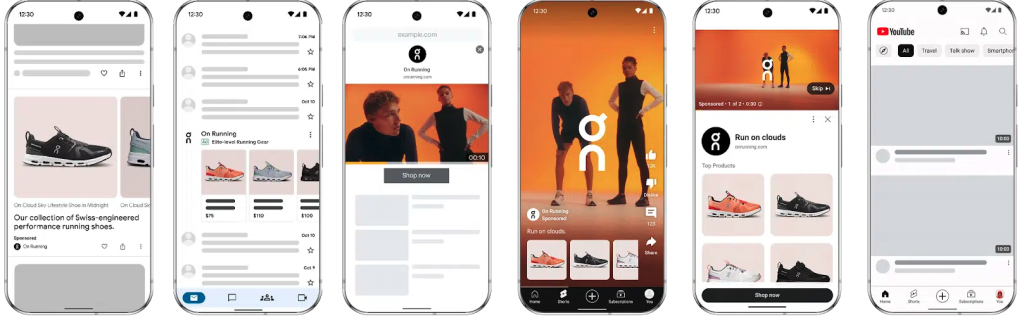
  • Performance Max (PMax): A goal-based campaign type that uses automation to show your ads across all Google channels (Search, Display, YouTube, Gmail and more) based on what’s most likely to drive results.
Performance Max campaign example
  • Demand Gen: A new campaign format designed to generate interest and demand using rich visual creatives across YouTube, Discover, and Gmail. Great for top-of-funnel awareness.
Demand Gen campaign example
Image credit: Search Engine Land

This means your brand shows up at key points in the customer journey, not just when someone’s actively searching, but also when they’re watching videos, browsing websites, or checking their email. You can use tools like audience targeting, remarking lists (retarget people who have already been to your website), and predictive search behaviour to reach people at different stages of the buying process.

This kind of visibility is especially valuable for small and medium-sized businesses. It helps you stay in front of potential customers, remind them what you offer, and gently guide them back when they’re ready to buy.

Common Challenges and How to Overcome Them

Bringing SEO and PPC together can be tricky, especially if you’re running a business with limited time and budget. You don’t need to spread yourself thin. Focus on the keywords that matter most and review your campaign regularly, so it works alongside your SEO.

Another challenge can be limited time. Many smaller teams simply don’t have the resource to manage both channels. In this case, using the right tools or working with a trusted agency can make a big difference.

Need help with syncing SEO & PPC?

At Brace, we’ve seen first-hand what happens when businesses bring SEO and PPC together. One of our clients in the home improvement sector saw website traffic increase by 93% and leads jump by 53% in just three months once both channels were working side by side.

For small and medium-sized businesses, this joined-up approach of using pay-per-click advertising and search engine optimisation can make a real difference. It gives you more visibility, more of the right visitors, and a better return on your marketing spend.

Ready to see what this could do for your business? Talk to the team at Brace Creative Agency. We’ll help you create a combined plan that gets results. Contact us today!

View Case Study